Doubles formation during attacks – Steve’s Badminton Blog and Website
We often see when going for attacks in doubles, the players tend to stack up. The player at the back would be attacking, and the player covering the front seems to go right in front of the attacking player. What gives? Let’s discuss.
Often times, in doubles, when a player at the back is going for a attack, the player at the front seems to retreat from his position close to the net to take up a position right in front of the attacking player. This is not the only formation available to doubles, far from it, but it is the most commonly used one. There are many advantages and disadvantages to this formation, let’s examine it.
When the attacking pair takes the stacking position, this limits the types of attacks which they can execute. The attacking player at the back can only send the attack straight down in between the opponents, or directly at the opponent he is facing. These positions for the attack forces the opponents to send a straight return over the first player, and it allows the attacking player to launch another attack. In my opinion, this is more of a brute force approach to attacking where the pair doing the attacking tries to break the opponent down by punching through their defences.
Stacking Up at the Sides
Observe the snapshot above. This is take from Day 1 of the Kumamoto Masters on Court 1. It is a match between the Lee twins against Kumagai and Nishi. I find that the Lee twins have a tendency to take up not good positions when attacking. This is one of them. In this snapshot, they stack up close to each other during the attack. But this stacking up is done at the sides of the court.
The position taken by the player in front limits the options for attack. Realistically, the options for attack are limited to the 2 I have highlighted. It is either Option 1, a straight attack or Option 2, an attack to the middle. And these attacks need to have sufficient power so that the opponent can only return it straight. If the power is not enough, the opponent can attack to send it cross court. When the attack is powerful enough, attempting to send it cross court can results is errors which send the shuttle out.
If the player chooses to attack on the right of the opponent to the sideline, Option 3, he risks the opponent doing a drive return cross court to the left, which is open as the player in front has taken a position straight in front of him.
If the player chooses to attack to the left, Option 4, which is a cross court attack, the opponent can block it to the net, or flick it straight. Both returns are not good as the player in front is not in a position to capitalize on them. A net return would mean the player in front has to lift, a flick straight would mean the attacking player has to rush across to get it.
Stacking Up at the Centre

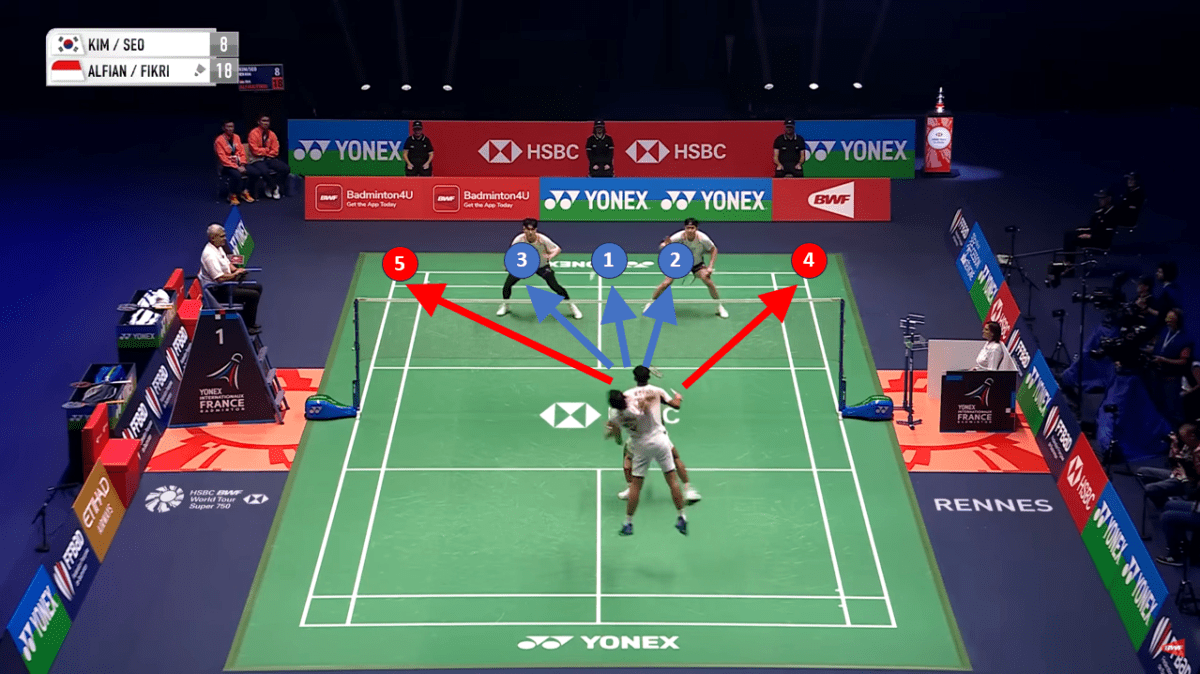
Now let’s look at Fikri’s attack. This snapshot is from the French Open where Alfian and Fikri played against Seo Seung Jae and Kim Wan Ho.
In this attack, Fikri is taking it from the centre and Alfian is right in front of him. As the attack in coming from the centre, they are stacked together. In this situaion, Fikri has 2 good options to attack, which are Option 1 and Option 2. These 2 option will force the opponent to return it straight, provided enough power is applied of course.
Option 3 can be considered, but only if Fikri can aim for the right pocket of Kim Wan Ho. If the attack sends it too far to his left leg, Kim Wan Ho can do a cross return. And, if Fikri uses this attack, Alfian needs to be alert to it and move right in front of Kim Wan Ho. He has to basically follow where the shuttle goes. If not enough power is used in the attack, then Kim Wan Ho will be able to do cross court net returns, or a flick to either side, away from the Indonesians. Due to this, Option 3 is a risky one to take.
Option 4 is not a good option. As the attack goes to Seo Seung Jae’s left, he may be able to do a cross court drive return, or a straight drive return. Both returns will leave the Indonesians stranded.
Option 5 is an even worst option as Kim Wan Ho can too do a cross court drive return, or a straight drive. Kim Wan Ho also has the option to block it straight to the net as it is far enough from Alfian.
Attacking from the Sides

The above is a snapshot from the same match between Alfian and Fikri against Seo Seung Jae and Kim Wan Ho. In this snapshot, Fikri is attacking from the side and Alfian has taken a position in the middle of the court. This formation allows for many options for their attack. It is really down to Fikri’s skills to launch attacks. If he is very skillful, he has even more options than those I noted down.
Option 1 and Option 2 are the usual options. Fikri can opt for a straight attack at Seo Seung Jae, or he can attack between the Koreans in the middle. Alfian is in a good position to follow up if he chooses to attack those positions.
Option 3 is to attack the sidelines right in front of Fikri. In this option, Alfian needs to be alert to a cross court return from Seo Seung Jae. This is because Seo Seung Jae will have 2 main options to return, which is a straight return or a cross court return. A cross court return will leave Fikri stranded as he will not able to reach it in time. Alfian has to intercept the return if it comes. And because Alfian has to be alert to cross court returns, it is Fikri’s task to move forward after his attack so that he covers the straight return which may come.
Option 4 is to attack cross court, to Kim Wan Ho’s left. This is a risky attack, as Kim Wan Ho will be able to send a straight block to the net, or drive it straight. Both returns require Alfian to cover. When Fikri launches an attack on Option 4, Alfian has to move to the shuttle and attack any returns which may come. Fikri will then have to return to the centre in the back and attack anything which comes his way. Kim Wan Ho is a bit off position, so if Fikri could launch a good steep sideline smash, it would be easy for Alfian to follow up as Kim Wan Ho’s return is not going to be very good.

In the snapshot above, we have Seo Seung Jae and Kim Wan Ho doing the attacking against Alfian and Fikri. This time, Kim Wan Ho is attacking from the opposite side, on the left. Seo Seung Jae takes a stack position near Kim Wan Ho, but… Seo Seung Jae is very dynamic as a player. He moves very quickly once he sees Kim Wan Ho’s attacks. He is a special case, as he is the best doubles player of this generation.
Kim Wan Ho has the same 4 options Fikri has from the earlier snapshot. Option 1 and Option 2 are the standard options he has. But with Seo Seung Jae’s position close to the centre, and we all know how quickly he moves towards the shuttle after he sees where Kim Wan Ho is attacking, he has the additional Option 3 and Option 4 as well. In fact, Kim Wan Ho has more options than just these 4. He can hit it anywhere as long as Seo Seung Jae moves to the shuttle where he is attacking.
Option 3 is a straight attack down the line. In this option, Kim Wan Ho will have to cover the straight line in front of him. He has to rush forward in case the opponents block it straight. Seo Seung Jae has to be alert for a cross court flick or net.
Option 4 is a cross court attack, and for this one, Seo Seung Jae has to move to that side of the court to attack any returns. Kim Wan Ho has to move to the centre at the back and be ready for the next attack.
Conclusion
In an earlier blog entry, I wrote about how Aaron Chia and Soh Wooi Yik became so much better and started winning titles. You can read about that in the link below. But, in a short summary, it is because they adopted the same formation used by Seo Seung Jae and Kim Wan Ho, as well as Alfian and Fikri shown here. Previously, they favoured the formation used by the Lee twins I shown above. And lately, Aaron Chia and Soh Wooi Yik seemed to have slipped back to their old habits, and they are now finding success hard to come by, again…
The stack formation is very powerful, when the attack is coming from the centre. But when attacking from the sides, the formation which is more approriate is the one where the player covering the front stands more towards the centre. In military terms, this is called a wedge formation. I think I will use the same term and call this the wedge formation.
The wedge formation is used by all the top pairs in doubles. And if you are able to use it in your gameplay, it would definitely make you a better doubles player.
That’s it for this entry.
Until the next entry, eat well, get plenty of rest and keep the badminton going!
Related Blog Entry:

Aaron Chia – Soh Wooi Yik has the unfortunate distinction of being the only doubles pair of losing 10 out of the 11 finals they were in for the earlier part of their careers. Now, they won 3 out of the 4 tournaments they were in, and in the space of 1 month, or within…
Football Prediction
Motivation
News
Pendidikan
Pendidikan
Download Anime
Sports News
website focused on news and information about the world of football. This is one of the popular websites in Indonesia accessed by sports fans, especially football enthusiasts, to get quick and reliable information.

Related Posts
How to Easily Beat a Difficult Boss in a PC Game
How to Skip the Grind in Open-World Games and RPGs