The Complete 7 Days to Die Farming Guide
Farming in 7 Days to Die has changed significantly over the years. Hoes are gone, crops no longer replant themselves, and most seed recipes are unlocked via magazines. Your old farming methods might no longer work. Our 7 Days to Die farming guide explains the full process. You’ll learn how to build Farm Plots, unlock seeds, grow crops, and increase every harvest.
Why Should You Farm in 7 Days to Die?
Farming in 7 Days to Die provides a reliable supply of food, drinks, and crafting ingredients. It reduces your reliance on kitchens, traders, and random loot. A farm also lets you control which resources are always available. You can grow ingredients for healing items, stamina drinks, and valuable recipes.

Which Crops Should You Grow?
The best crops in 7 Days to Die depend on the recipes you’ve unlocked. Growing every available plant right away is rarely efficient. Start with ingredients you can already cook or use.
Corn and potatoes are strong first choices. They appear in several useful recipes and remain relevant throughout your playthrough. A steady supply gives you more freedom when preparing meals.
Mushrooms are another valuable crop. They are needed for recipes such as Vegetable Stew and Steak and Potato Meal. They also grow without sunlight and do not require a Farm Plot.
After securing your basic food supply, consider these plants:
- Aloe for healing items
- Goldenrod for Goldenrod Tea
- Chrysanthemum for Red Tea
- Coffee for stamina-focused drinks
- Hops for beer
- Pumpkins for specialized meals
- Blueberries for food and medical recipes
Cotton is less urgent in 7 Days to Die because cloth is easy to find elsewhere. You can collect it by scrapping clothing, curtains, and other fabric items. Grow cotton when you need a reliable supply near your base.
Super Corn is valuable, but it’s not your best starting crop. Access usually comes later, and it doesn’t replace basic food production. Treat it as a specialized resource once your main farm is stable.
How to Prepare Your Farm
Earlier versions of 7 Days to Die let you cultivate soil with a hoe. That system is no longer part of the current game. Most crops must now be planted in dedicated Farm Plot blocks.

You can unlock the Farm Plot recipe by reading Southern Farming magazines. The required materials include common resources and several items gathered during exploration. Rotting Flesh and Nitrate Powder are often the hardest to collect early.
Follow these steps to build your first farm:
- Read enough Southern Farming magazines.
- Gather the materials needed for Farm Plots.
- Craft several Farm Plot blocks.
- Choose a protected location near your base.
- Place the Farm Plots in organized rows.
- Leave enough sunlight and vertical space.
- Equip your seeds and plant them.

Your farm in 7 Days to Die should remain separate from your main defensive position. Zombies, explosions, missed attacks, and vehicles can damage your plants. A quiet roof or an enclosed courtyard is usually safer than the front entrance.
Rooftop farms can work very well, especially in cities. Farm plots are heavy, so check the structural support beneath them. A large, unsupported roof can collapse once several plots are added.
Recommended Farm Layout
A clear layout makes planting and harvesting in 7 Days to Die much faster. It also reduces the risk of hitting the wrong crop or driving across the field. Straight rows are easier to manage than scattered Farm Plots.

Start with rows of five plots and leave walking space between sections. Grouping identical crops together simplifies storage and replanting. You can then expand each section whenever more seeds become available.
A practical layout could use:
- Two rows for corn
- Two rows for potatoes
- One row for aloe
- One row for drink ingredients
- A separate wall for mushrooms
- A storage box near the entrance
Living Off the Land and Southern Farming
Two progression systems govern modern farming in 7 Days to Die. Southern Farming magazines unlock recipes, while Living Off the Land increases your harvest. You need both systems for the best results.
Reading Southern Farming magazines increases your farming crafting skill. Higher levels unlock Farm Plots and additional seed recipes. Living Off the Land also increases your chance of finding these magazines in relevant loot.

The Living Off the Land perk has five ranks:
- Rank 1: Doubles harvests and reduces Farm Plot costs
- Rank 2 and 3: Adds a chance for one extra crop
- Rank 4 and 5: Triples the standard harvest amount
Without the perk, you receive one item from a wild plant. A crop you’ve grown normally yields two items. Living Off the Land increases both yields considerably.
Seed recipes in 7 Days to Die aren’t unlocked directly by the perk. This changed with the introduction of the magazine system. Spend perk points for better yields, then keep searching for magazines to expand your seed selection.
How to Plant Seeds
Most seeds in 7 Days to Die can be planted only on a Farm Plot. Ordinary dirt and soil aren’t suitable for normal crops. Place your plots first, then select the seed from your toolbelt.
Follow these steps when planting:
- Equip the seed you want to use.
- Aim at the top of an empty Farm Plot.
- Check that the placement outline appears.
- Use the secondary action button.
- Confirm that a seedling appears.
Each Farm Plot holds one plant. Different species can grow alongside each other without causing problems. You don’t need to separate corn, potatoes, and other crops.
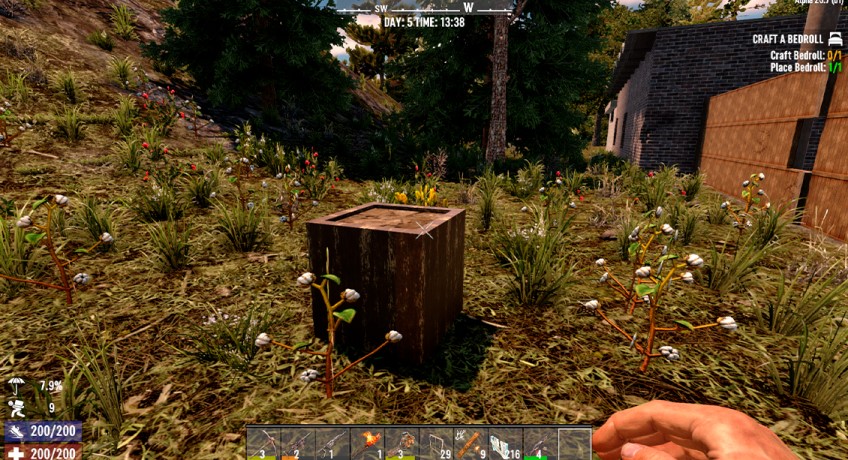
Corn grows much taller than most plants in 7 Days to Die. Leave several blocks of open space above it. Low ceilings can prevent proper placement or make the farm difficult to navigate.
Mushroom spores work differently from other seeds. You can attach them to many floors, walls, and other suitable surfaces. They don’t require sunlight or a Farm Plot.
Vertical farms are possible when carefully planned. Each floor still needs enough natural light for ordinary crops. Add skylights and open shafts instead of relying on artificial lighting.
Which Seeds Are Available?
7 Days to Die includes food crops, medicinal plants, crafting resources, and several trees. Most crop recipes become available through Southern Farming magazines. Seeds can also appear as loot or in trader inventories.
Food and Drink Crops
- Corn
- Potato
- Blueberry
- Pumpkin
- Mushroom
- Coffee
- Yucca
Medical and Crafting Plants
- Aloe
- Chrysanthemum
- Goldenrod
- Cotton
- Hops
Special Crop
Super Corn is a rare crop tied to specific locations and discoveries. Its seed recipe doesn’t follow standard farming rules. Save any Super Corn or seed recipes you find.
Trees
Plant them directly in suitable ground and leave plenty of room between them. Dense tree farms can reduce visibility and game performance.
How Much Light Do Crops Need?
Almost all crops in 7 Days to Die require natural sunlight. Outdoor farms receive sufficient light without additional planning. Indoor and underground farms need openings that let sunlight reach the plants. The game measures sunlight on a scale from 0 to 15. Full outdoor sunlight is 15. Normal crops require a sunlight value of at least 8 to continue growing.

Sunlight can pass directly through an opening above the farm. It can also spread sideways across a limited area. This lets you create indoor farms beneath skylights without removing the entire roof.
Keep these rules in mind:
- Use open skylights above indoor crops
- Avoid thick blocks between crops and the sky
- Leave space around each sunlight opening
- Check crops regularly for stalled growth
- Never rely on torches or electric lamps
Artificial lighting doesn’t replace sunlight. A room may look bright yet remain unsuitable for crops. When a plant stops developing, inadequate sunlight is usually the first thing to check. Mushrooms are the main exception. They don’t need sunlight and can grow inside enclosed rooms.
How the Growth Cycle Works
Every crop in 7 Days to Die goes through three visible growth stages. It begins as a seedling, develops into a growing plant, and finally matures. Only mature plants yield the full harvest. Aim at a crop to see its current name and stage. This is the easiest way to check whether it’s ready. Mature plants remain available until someone harvests or destroys them.

Crops grow in real time, according to the current game settings. Server settings can therefore change how quickly a field develops. Different crops may also require different total growth times. Harvesting an immature plant normally returns its seed. This lets you move something planted in the wrong place. The growth process restarts once you plant that seed again.
You don’t need to water crops or add fertilizer. There’s also no soil exhaustion. You can grow the same crop in one Farm Plot for as many cycles as needed.
How to Harvest Crops
Before harvesting in 7 Days to Die, check each crop’s stage. A fully grown plant will be clearly labeled as mature. Harvesting too early only returns the seed and resets its progress. Mature crops are harvested with a melee attack. You can use your hands, a weapon, or a tool. Your chosen item doesn’t change the basic crop yield.

Wild and cultivated plants behave differently:
- Wild plants provide a smaller harvest
- Wild plants disappear after harvesting
- Cultivated crops provide a larger harvest
- Cultivated crops may return one seed
- Living Off the Land improves both harvest types
Cultivated plants don’t automatically return to their first growth stage. Once harvested, the Farm Plot becomes empty. You must plant another seed to begin the next cycle. Farmer equipment can further improve your results. Put on your Farmer Outfit and Farmer Boots before harvesting. Once the field is cleared, store the equipment again and replant your seeds.
Upgrade Your Farm With PLITCH!
A successful farm provides ingredients for meals, drinks, and medical supplies. Gathering the first seeds and Farm Plot materials can still take time, especially during a new playthrough.
The 7 Days to Die cheats from PLITCH let you customize your single-player experience. You can adjust selected resources and survival stats, then focus on farming, crafting, or building your base.
Use PLITCH to tailor the game to your preferred difficulty. You can reduce repetitive gathering or make survival more challenging. These options give you more control over your journey through Navezgane.
Check out our YouTube channel to learn more about PLITCH!
Happy Gaming!
Read more about PLITCH:
PakarPBN
A Private Blog Network (PBN) is a collection of websites that are controlled by a single individual or organization and used primarily to build backlinks to a “money site” in order to influence its ranking in search engines such as Google. The core idea behind a PBN is based on the importance of backlinks in Google’s ranking algorithm. Since Google views backlinks as signals of authority and trust, some website owners attempt to artificially create these signals through a controlled network of sites.
In a typical PBN setup, the owner acquires expired or aged domains that already have existing authority, backlinks, and history. These domains are rebuilt with new content and hosted separately, often using different IP addresses, hosting providers, themes, and ownership details to make them appear unrelated. Within the content published on these sites, links are strategically placed that point to the main website the owner wants to rank higher. By doing this, the owner attempts to pass link equity (also known as “link juice”) from the PBN sites to the target website.
The purpose of a PBN is to give the impression that the target website is naturally earning links from multiple independent sources. If done effectively, this can temporarily improve keyword rankings, increase organic visibility, and drive more traffic from search results.

Related Posts

8 Great Underwater Games to Explore the Unknown

How to Enjoy PC Games With Limited Time